The video below looks at the work of Luc Tuymans (which is worth getting to know, if not outright worshipping). he could drag his works behind the car on the way to a gallery and still get hundreds of thousands for them. But, what happens when he puts his work out in the street, on a concrete wall? out of context, how is his work viewed? the video reveals...
I also typed up a big long debate about how art should do more to entice the viewer, but it sounded cheezy, so just enjoy the video.
Thursday, April 24, 2008

Sunday, April 20, 2008

목켸 The monkey man

..수,당,송,원,면,청..
..Soo, Dang, Song, Won, Myun, Chung..
I had a brief lesson about the different periods in Chinese history. I asked a studio-mate about a book he was reading that traced the history of chinese painting, and ended up in a discussion about a few of the works.
This was done by an artist with a name that sounds like "Monkey" after you translate it into Korean, and further degrade it into English. He worked in the Song dynasty, which falls in about 1200AD. The balance between detailed areas, and completely empty areas I find interesting in this work, as is the easy manner in the execution.
Calligraphy class
Turtles and more turtles

the history of the symbol for turtle, as taken from various original sources. The childlike quality that the works possess are part of the style that an artist tries to capture when executing these symbols, as Professor Song demonstrated when he began his demonstration by smashing a brush loaded with ink onto a sheet of rice paper, violently working his way through one of the symbols, leaving rips through many spots of the practice paper. The class applauded.
Professor Song is a character. His classes typically begin with an hour of him running through a lesson - he sets up to demonstrate something, then starts talking, brush still in hand. then he'll make like he is going to demonstrate, only to dip the brush in the ink, hover over the paper, and return to talking. His english is terrible, but he loves to pop in english words while he is talking, just to make me feel comfortable. If he goes a while and doesn't come up with an english word, he pauses to ask me and the class what the english word is for whatever he is talking about, so he can add that to his vocabulary. He is amusing, patient, and friendly.
Here he is helping me,
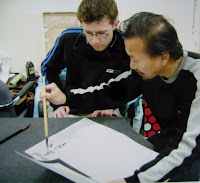
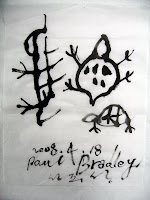
and here is a little work he did for me, based on the turtle pages. The jealousy of the other students was palpable as he signed it and gave it to me.

the history of the symbol for turtle, as taken from various original sources. The childlike quality that the works possess are part of the style that an artist tries to capture when executing these symbols, as Professor Song demonstrated when he began his demonstration by smashing a brush loaded with ink onto a sheet of rice paper, violently working his way through one of the symbols, leaving rips through many spots of the practice paper. The class applauded.
Professor Song is a character. His classes typically begin with an hour of him running through a lesson - he sets up to demonstrate something, then starts talking, brush still in hand. then he'll make like he is going to demonstrate, only to dip the brush in the ink, hover over the paper, and return to talking. His english is terrible, but he loves to pop in english words while he is talking, just to make me feel comfortable. If he goes a while and doesn't come up with an english word, he pauses to ask me and the class what the english word is for whatever he is talking about, so he can add that to his vocabulary. He is amusing, patient, and friendly.
Here he is helping me,

and here is a little work he did for me, based on the turtle pages. The jealousy of the other students was palpable as he signed it and gave it to me.

Work for the sake of it

Recently felt that I was not getting any real work done. I go through page after page of paper, practicing how to make a line, trying to duplicate what I see in other works or in real life, and then trying again. I talked to a friend who studied oriental painting. She said that, for the first year, she did nothing but grind ink and coloured pigments, and was allowed to only make single brushstrokes on a page. A whole YEAR of single strokes, over and over. I am beginning to understand why.
Anyway, practice is not really work, and I was starting to get the feeling that my peers were wondering when I was going to produce any more than crappy chinese letters and shaky sketches of trees. So I did the sketch above to simply have something to look at in the studio. I was told that it was timid. Supposedly the one below is better, but I still can't entirely figure out why.

Basically, everyday is like trying to figure out a puzzle for which I have not been given the guiding rules - its like being given a five-star Sudoku to solve without being told that you cannot use each number more than once in a row.
I am starting to make some good connections. I have met this Chinese guy named Ryang Sung Kim(김량성), or Curtis, as he intruduces himself to English native speakers. He is fluent in Korean (his parents are of Korean descent), and comfortable in English and Japanese. He is studying Western painting at Hong ik University, and has good ties to the Chinese contemporary art scene. He is currently curating an exhibition of 50 asian artists for a show in Beijing. He is also going to introduce me to a sculpture professor at the university the week. His art is similar to my tighter work, and I hope to do some work with him, or to see how we can help each other out in the future. I am also setting up appointments with various other professors at the university for this week and next. Connections, connections, connections.
Thursday, April 17, 2008
Finally..
..found what I was looking for. And even though I did not get to see Professor Kim Ho Seok (김호석) today, because I opted to eat lunch instead (the class ran until 1pm, and he was likely to be more concerned with filling his stomach than engaging in a conversation about his art with a foreigner with poor korean-speaking ability), I will likely arrange the opportunity to meet sometime in the future.


From what I understand, he was born in the 50's, and has spent the bulk of his career doing ink drawings of traditional houses, portraits, and peasants. Boring. Then, about five years ago he changed directions, and started interpreting the lives of the people of northern asia in his wonderfully composed, confident, sketches. Remarkable in their absolute mastery of line - the speed, pressure, flow, bleed, colour, consistency, thickness and weight of each is made to look easy and everyday. the works shown here are mostly just details. If you do not click on the images to see the larger versions, you're missing out.


From what I understand, he was born in the 50's, and has spent the bulk of his career doing ink drawings of traditional houses, portraits, and peasants. Boring. Then, about five years ago he changed directions, and started interpreting the lives of the people of northern asia in his wonderfully composed, confident, sketches. Remarkable in their absolute mastery of line - the speed, pressure, flow, bleed, colour, consistency, thickness and weight of each is made to look easy and everyday. the works shown here are mostly just details. If you do not click on the images to see the larger versions, you're missing out.


Wednesday, April 16, 2008
SEMA Selected emerging artists 2008
Located right outside the walls of a wonderful little palace is Seoul Museum of Art. Pardon the lack of names - On the museum website, in both korean and english, there is no list of the participants! I have a brocure kicking around somewhere, and if i can find it, i will update accordingly.

Our first no-name artist does these wonderful paintings. built of layers of movement, the depth surges forward and receedes, especially in this specific one, which appreas abstract. Others were much more obviously "something", like layers of outlines of a horse, for example, and the easily-recognizable subject sorta ruined it for me.
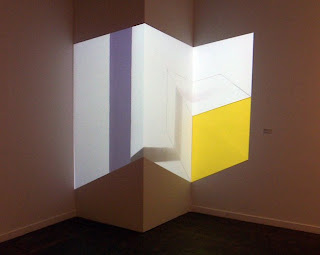
Emerging artists possess that quirky ability to surprices sometimes, and finding an interesting and fresh way to show basic geometric shapes after the 20th century is quite the trick.
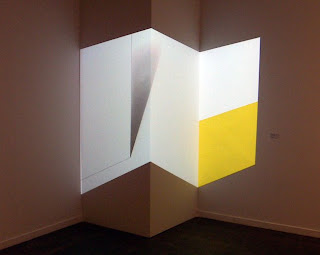
Projected into the corner of the gallery space, and with the corner rebuilt so it juts back out into the viewers' space, is a slowly-progressing video. Every few seconds a small change or two can be detected - something will be added or taken away. I wonder if the changes are pre-programmed, or if maybe they are random, or better yet, somehow an external force is making the changes?
The Good Stuff
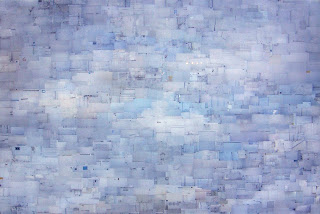
Somewhere in the middle of the exhibition was all the best stuff. This body of work was a series of crazy-thin lightboxes. the images, about six feet across, were made of tiny photographs of urban settings that shared a specific colour. In this case, the subject was powder-puff blue garage doors and storefront protectors, the kind that typically roll up or swing open.
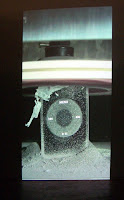
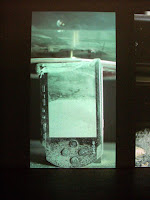
While some rock n' roll song that sounded similar to a rough old rolling stones song played in the background, three videos on high speed and in reverse showed a handphone, and ipod, and a hand-held videogame starting as dust and getting a reverse-grinding to emerge whole and functional again.
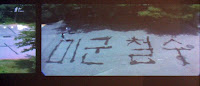
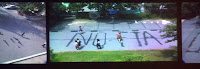
The crappiest of protests, this artist displayed a collection of videos of short-lived, ineffective protest. repeatedly dragging a mop over his words to keep them from evaporating, the artist silently goes about protesting high tuition, American soldiers, and the Free Trade Agreement that has been coming into effect in South Korea (causing drastic changes) as people continue with their lives, oblivious to the words on which they tread.
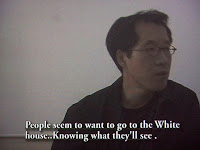
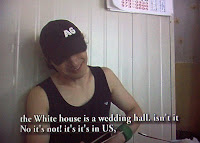
A satirical ten-minute video looking at the us of the word "White House" in South Korea. A symbol of power, the name has been confiscated by those with wedding halls, restaurants, and karioke businesses. Some know that there is a White House in the US, in which the president lives and works, and some do not. (The consensus reached in the video is that, associating a business with the White House does not seem to affect patronage one way or the other)

Our first no-name artist does these wonderful paintings. built of layers of movement, the depth surges forward and receedes, especially in this specific one, which appreas abstract. Others were much more obviously "something", like layers of outlines of a horse, for example, and the easily-recognizable subject sorta ruined it for me.

Emerging artists possess that quirky ability to surprices sometimes, and finding an interesting and fresh way to show basic geometric shapes after the 20th century is quite the trick.

Projected into the corner of the gallery space, and with the corner rebuilt so it juts back out into the viewers' space, is a slowly-progressing video. Every few seconds a small change or two can be detected - something will be added or taken away. I wonder if the changes are pre-programmed, or if maybe they are random, or better yet, somehow an external force is making the changes?
The Good Stuff
Somewhere in the middle of the exhibition was all the best stuff. This body of work was a series of crazy-thin lightboxes. the images, about six feet across, were made of tiny photographs of urban settings that shared a specific colour. In this case, the subject was powder-puff blue garage doors and storefront protectors, the kind that typically roll up or swing open.


While some rock n' roll song that sounded similar to a rough old rolling stones song played in the background, three videos on high speed and in reverse showed a handphone, and ipod, and a hand-held videogame starting as dust and getting a reverse-grinding to emerge whole and functional again.


The crappiest of protests, this artist displayed a collection of videos of short-lived, ineffective protest. repeatedly dragging a mop over his words to keep them from evaporating, the artist silently goes about protesting high tuition, American soldiers, and the Free Trade Agreement that has been coming into effect in South Korea (causing drastic changes) as people continue with their lives, oblivious to the words on which they tread.
A satirical ten-minute video looking at the us of the word "White House" in South Korea. A symbol of power, the name has been confiscated by those with wedding halls, restaurants, and karioke businesses. Some know that there is a White House in the US, in which the president lives and works, and some do not. (The consensus reached in the video is that, associating a business with the White House does not seem to affect patronage one way or the other)


Monday, March 17, 2008
Adina edwards' new work


My buddy Adina. We exhibited our works together in mid-March. I was responsible for writing a critique of her work, but found little to criticize. The condom bed functions really well as a stand-alone piece. she debated putting up drawings with it, but correctly settled for the bed and the bed alone. Her work is concerned with social responsibility and harm reduction. Aids and STD's run rampant through through the low-class sex trade, and Adina has put together a piece that opens that seedy world to debate among the art-versed. It presents a new face of the use of the bed in the history of art, where it is most typically used as a prop-device for some too-young Venus.
and yes, those are hundreds of hand-stitched condoms.
Thursday, January 31, 2008
cold in Calgary
So I got a copy of China Art Book. It is not everyday that you find a book about Chinese artists.. ..written by two Gremans. It is kickass, though, and recommend the purchase to anyone interested in Chinese Art. It is kinda important, and there is nothing really out there about it, aside from superficial introductions in big galleries, in the West. More attention should be paid to the crazy cool stuff coming out of China, Japan, and South Korea. Taiwan too, I am more recently learning, has some impressive stuff to show the world.
from the book, I have found certain artists expecially deserving of a look (though it is trycky to find anything (in english, at least) about some of them.
sun xun
does animations, other stuff. likes mosquitos, but i do not know why. quoted as saying "each image is a negation of the previous one", which I thought is an interesting way to think about animation. It contrasts highly with my recent interest in Japanese Metabolism, which deals with capturing various speeds in the same time.
liu ding
likes strange lighting. most of his stuff kicks ass, but he did this one thing with artists reproducing works in 2005 that I think sucks ass
wang qingsong
i wish i had thought of that.
Zhou chunya
is sort of doing the same thing a lot. but the painting is so good, that it really doesn't matter. I saw his stuff in Seoul about five years ago, and really wish I had bought a work - it would be worth significantly more now, if i could part with the enchantingly-slick liquidy-oil paintings of dogs.
cai guoqiang
like zhou, has been around a while. Surprising, considering he works with gunpowder.
from the book, I have found certain artists expecially deserving of a look (though it is trycky to find anything (in english, at least) about some of them.
sun xun
does animations, other stuff. likes mosquitos, but i do not know why. quoted as saying "each image is a negation of the previous one", which I thought is an interesting way to think about animation. It contrasts highly with my recent interest in Japanese Metabolism, which deals with capturing various speeds in the same time.
liu ding
likes strange lighting. most of his stuff kicks ass, but he did this one thing with artists reproducing works in 2005 that I think sucks ass
wang qingsong
i wish i had thought of that.
Zhou chunya
is sort of doing the same thing a lot. but the painting is so good, that it really doesn't matter. I saw his stuff in Seoul about five years ago, and really wish I had bought a work - it would be worth significantly more now, if i could part with the enchantingly-slick liquidy-oil paintings of dogs.
cai guoqiang
like zhou, has been around a while. Surprising, considering he works with gunpowder.
Friday, January 04, 2008
Good art Link

The First Post
has a really good art site - lots of links to chinese artists, too.
pic is from the site.
Saturday, December 29, 2007
Sunday, November 25, 2007
Thesis work
David Cushway does stuff about traces that are left behind by individuals. some of it is boring stuff, like shots of a pot getting smashed, but most of it looks pretty interesting

this is a work from 1996 - Cushway put unfired bricks down on the floor of his studio for six months to record what was happening.Then, he fired 'em, and called it art.

this is a work from 1996 - Cushway put unfired bricks down on the floor of his studio for six months to record what was happening.Then, he fired 'em, and called it art.
Subscribe to:
Posts (Atom)